
Offices, Workshops and Factories in Wadeville: DStv for a Business, Not a Lounge
Wadeville sits roughly three and a half kilometres from the middle of Germiston, and it does not look like the rest of the town. It is an industrial area built around the railway, and the buildings show it: steel portal frames, sheet-metal roofs, high ceilings, long internal distances and a reception area that can be a hundred metres from the floor where people actually work. Put a satellite installation into that and almost none of the assumptions from a suburban house survive.
This is a guide for the person who has been asked to "sort out the TV" at a Germiston business — a workshop canteen, a dealership waiting room, an office boardroom, a factory reception. The dish is the easy part. Everything after it is where the money and the mistakes are.
A Business Subscription Is Not a Home Subscription
The first thing to get straight is that a residential subscription and a commercial one are different products, bought differently. MultiChoice sells the commercial side as DStv Business, and on its own DStv Business page it splits the offering into three named packages, telling you to "Choose one or more of our tailored DStv Business packages to meet your unique business needs."
Those three are aimed at visibly different premises. In DStv's own words:
- DStv Work — "Perfect for your: School/University | Office/Corporate | Government Office | Bank/Reception"
- DStv Play — "Perfect for your: Pub/Bar | Shop/Restaurant | Tavern/Shebeen | Stadium/Arena"
- DStv Stay — "Perfect for your: Hotel/Guesthouse | Bed & Breakfast | Retirement Village | Clinic/Hospital"
Two things follow from that. The first is that the package is billed per TV per month rather than per building — DStv's page prices each one "PM/TV" — so the number of screens you plan for is a subscription decision, not just a cabling one. The second is that the application goes to DStv. We are an installation business: we put the dish up, run the cable and set the screens up. We do not sell you the subscription and we cannot approve one, so work out which package fits before the install is booked rather than after.
The Building Decides the Job, Not the Dish
On a house, the distance from dish to decoder is usually short enough that nobody thinks about it. In an industrial building it is frequently the single largest factor in what the installation costs and whether it is reliable in two years' time.
Distance, and What It Costs You
Signal weakens over a cable run. That is not a brand problem or a quality-of-installer problem, it is physics, and the longer the run the less margin you have left for a connector that corrodes or an LNB that starts to age. It is worth knowing that DStv says this out loud on its accredited installation page: "There may be added costs for additional travel, cabling or amplification required – all, which are for your account. Please confirm requirements with your installer before the installation."
Read that as a warning about premises exactly like Wadeville's. If the dish has to go on the roof of a workshop and the screen is in an office on the far side of the building, the cable is a real line item, and amplification may be too.
One Dish, Several Screens
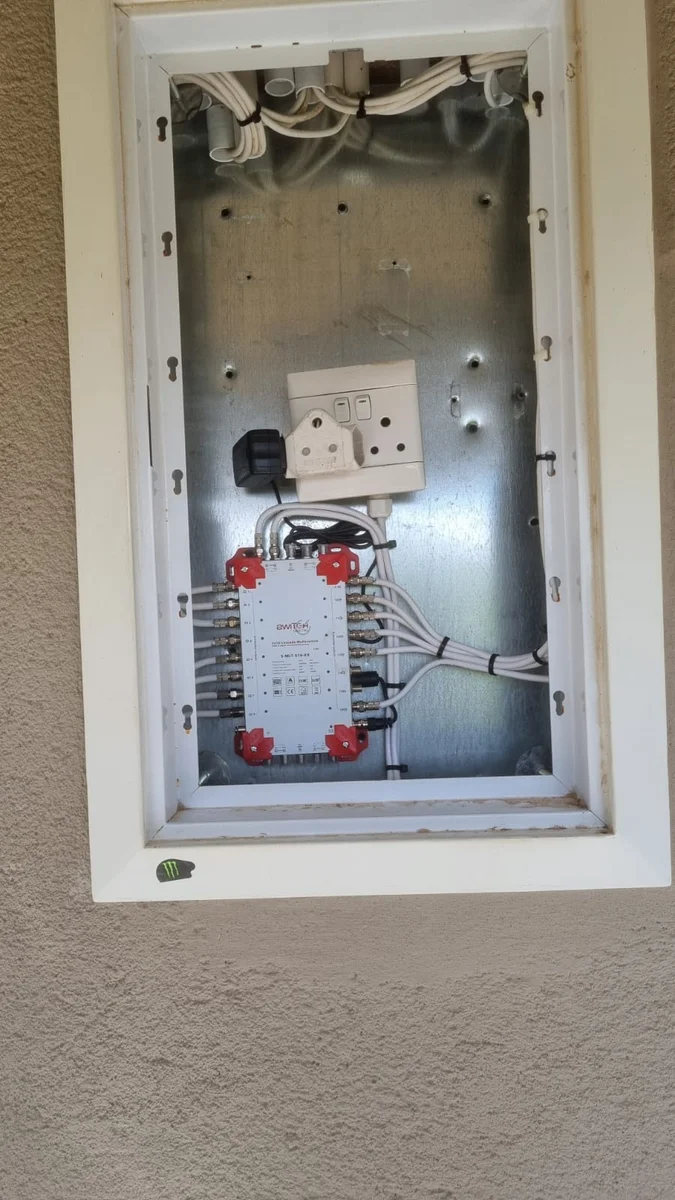
Where a business wants more than a couple of screens, the sane approach is one dish feeding a distribution point, rather than a dish per TV. That distribution hardware — a multiswitch and the cabling manifold around it — wants to live somewhere dry, ventilated, lockable and reachable without a scissor lift. The worst place to discover you did not plan for it is after the ceiling is closed.
Steel Roofs and Mounting Points
Industrial roofs give you a lot of surface and very few good anchor points. A bracket wants structure, not sheeting, and it wants to be somewhere a technician can reach again later without the building being shut down. It also wants to be somewhere a roof sheet can be replaced around it. None of that is difficult, but all of it is cheaper to decide before the first hole is drilled.
Who Owns the Wall?
Most industrial premises are leased. Fixing a bracket to the building, running cable through a wall, or penetrating a roof membrane is usually a landlord matter, and on a roof with a waterproofing guarantee it can be a condition of that guarantee. Ask before, not after. The same principle applies to a body corporate in a commercial park.
Where the Dish Actually Points
This is the part people expect to be complicated and it is not. DStv does not publish which satellite carries its signal or where that satellite sits, so we work it out from the operator's material instead: Intelsat's own product sheet for IS-20 places that spacecraft at 68.5° East. The bearings below are our arithmetic from that position, not a DStv figure.
From Germiston, which sits at roughly 1,630 metres above sea level, the dish looks east-north-east — about 62.5° on the compass — at an elevation of roughly 36° above the horizon, with the LNB rotated about 53°.
One caveat that matters more than the numbers. Those figures are not special to Germiston, or to Wadeville. Run the same calculation anywhere across the East Rand and the answer moves by about two tenths of a degree, which is far finer than anyone can set a bracket by hand. There is no such thing as a suburb-specific alignment. What differs between one site and the next is not the aim — it is what is standing in the way of it, which on an industrial site usually means a neighbouring building, a parapet, or your own roof plant.
That 36° elevation is worth sitting with, though. It is a fairly shallow angle — the dish is looking out across the sky rather than up at it — so an obstruction does not have to be tall to matter if it is close.
What to Work Out Before You Call
You will get a far more accurate quote, and a far shorter site visit, if you can answer these:
- How many screens, and in which rooms?
- Roughly how far is the furthest screen from where a dish could go?
- Is the building owned or leased, and who signs off on drilling?
- Is there a lockable, dry spot for distribution equipment?
- Are the screens already on the wall, or is mounting part of the job?
- Does anything need to keep working during business hours while we install?
Our commercial installation page covers the kinds of premises we work in, and the fastest way to get a number for your specific building is to send us the details — floor area, screen count and whether the roof is accessible will get you most of the way to a quote without anyone driving out.
A Word on Realistic Expectations
A commercial installation is not a bigger version of a home one, and a quote that treats it as one is usually a quote that has not looked at the building. Equally, most Wadeville jobs are not exotic. Once the run length, the mounting point and the distribution location are settled, the actual work is ordinary — it is the planning that is specific to you. If you would rather start with the basics of what an install involves, the Germiston DStv installation overview is the plainer read.
Frequently Asked Questions
Can I just use a normal home DStv subscription in my business?
DStv sells separate commercial packages — Work, Play and Stay — and describes on its business pages which kinds of premises each is intended for, from offices and banks through to pubs, shops and guesthouses. Which product your premises should be on is a question for DStv or the business-sales channel, not for an installer. We fit the equipment; the subscription is between you and MultiChoice.
How many TVs can run off one dish?
More than most businesses need, provided the distribution is designed for the number at the start. The limit in practice is rarely the dish — it is the multiswitch specification and the cable runs. Tell us the final screen count you might reach, not just the number you are installing now, because upgrading distribution later means opening ceilings again.
Will a long cable run inside a factory cause problems?
It can, and it is the most common reason a commercial installation is more expensive than the customer expected. Signal is lost across distance, so a very long run may need amplification. DStv's own installation terms flag added costs for "additional travel, cabling or amplification required", so it is a known factor rather than an upsell — but it should be identified and quoted before the work starts, not discovered afterwards.
Do you need roof access to quote?
Not always. For a straightforward office or reception we can usually quote from a description and photographs. For a larger premises with multiple screens, a site visit is genuinely worth it, because the position of the distribution point and the route of the main cable are what drive the cost, and neither is visible in a photo of the reception desk.
Need Help with Your DStv?
Get help with DStv installation, signal faults and XtraView in Germiston and across the East Rand. Call or send a message for a no-obligation quote.