
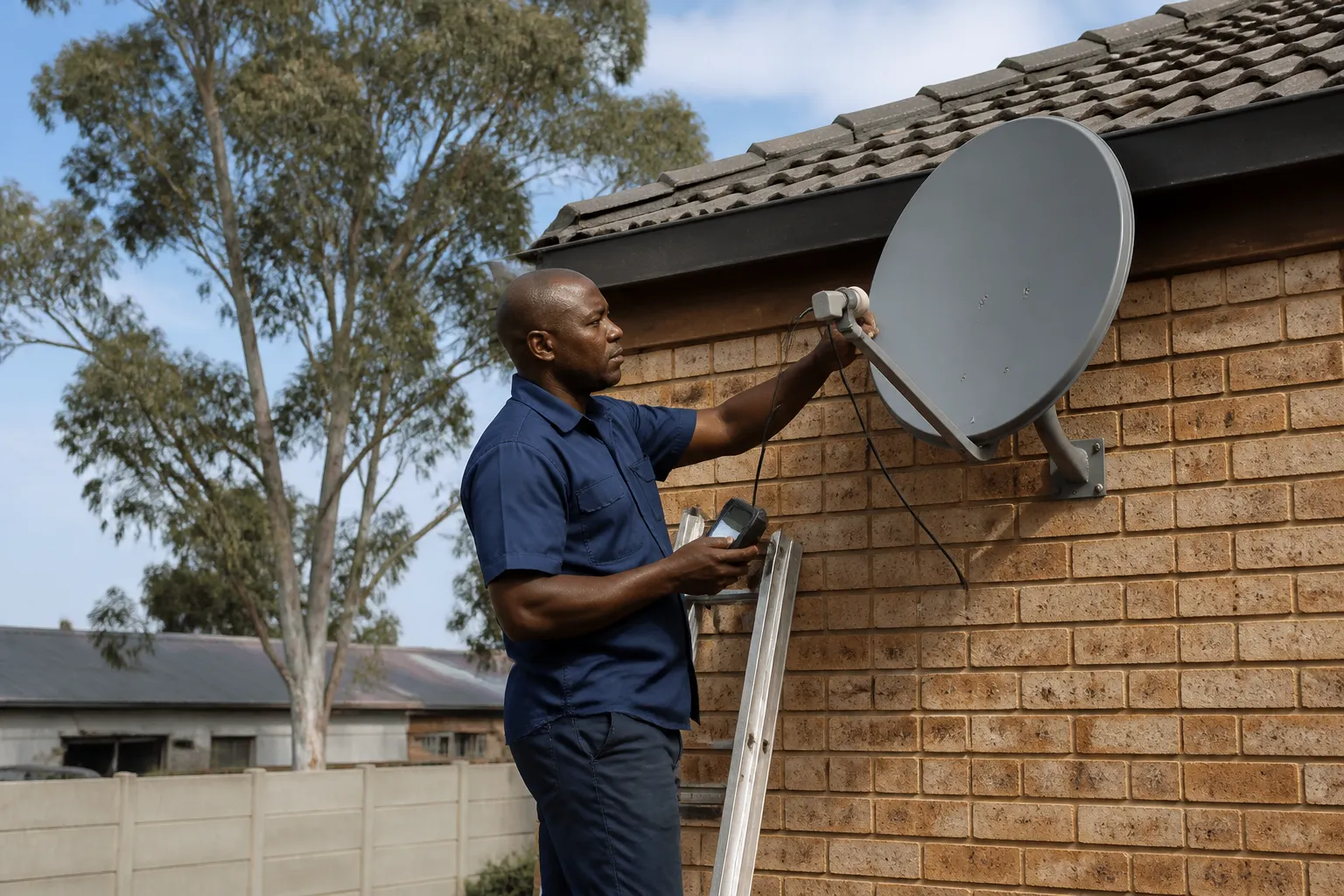
DSTV Installation in Parkhill Gardens
The single most common reason a dish in an established suburb like Parkhill Gardens works in winter and struggles in summer is a tree. A satellite signal needs a clear path; leaves and wet branches absorb it. A dish positioned in August, when a jacaranda or a plane tree is bare, can be sitting behind a wall of foliage by December. We plan around the tree the garden will have, not the one standing there on the day.
Working out what the dish can actually see
Before drilling we sight along the line the dish has to look down and note anything in it — a canopy, a neighbour's tree, a chimney, a satellite dish already on a wall. Then we take meter readings from more than one position. A spot that reads acceptably today but has a branch a metre off the line is not a good spot; a slightly less convenient wall with clear air in front of it is.
Where the garden simply has no clear line at ground level, the options are a higher mount on a gable or a position on the other side of the house with a longer cable run. Both are ordinary jobs. What we will not do is fit the dish somewhere we already know is marginal and leave you to discover it when the picture starts breaking up.
When an existing dish suddenly goes marginal
If DStv has worked for years and has recently started pixelating or dropping out, growth is one of the first things worth ruling out. The tell is a fault that is worse in the evenings, worse after rain, and worse in summer than in winter. A signal meter at the dish settles it quickly: if the reading is poor at the LNB itself, nothing further down the cable is going to fix it.
Trimming is sometimes the answer and sometimes not — it is your tree and your call, and a branch that grows back puts you in the same position next season. Relocating the dish to a position that will still be clear in five years is usually the better spend. We give you the meter readings for both so the decision is an informed one.
Second rooms and tidy cabling
Once the dish is in a good position, adding a second TV point is straightforward. Extra View links a second decoder to your existing subscription so the lounge and a bedroom can watch different channels, and each decoder gets its own cable from the LNB rather than sharing one through a splitter.
Cable across a garden is the part that gets damaged: a spade, a lawnmower or a dog will find any slack. Runs are clipped tight to walls, taken through conduit where they cross open ground, and kept away from anything that gets moved around.
What a visit to Parkhill Gardens covers
See the full list of DStv services we offer, or read about Extra View multi-room setups. Also nearby: Lambton and Klippoortje A.L..
Need DStv Sorted in Parkhill Gardens?
Send a photo of your dish and decoder on WhatsApp, or use the contact form, and we'll come back to you with a quote.
Call for a Quote